A good LED makeup mirror should provide steady, even light—not a bright reflection that pulses while you apply eyeliner. In 2026, the best models pair adjustable brightness and accurate color rendering with dependable power connections. Yet even a well-reviewed mirror can flicker after months of daily use. Small details matter: a loose USB plug, a tired adapter, or a dimmer set near its lowest level can all affect the light.
If you’re asking, “why is my led makeup mirror flickering,” start with the simple checks. Try another compatible outlet or power adapter, reseat the cable, and test the mirror at a higher brightness setting. Notice whether the flicker changes when you touch the cord or rotate the dimmer. That pattern can help narrow down the cause without opening the housing. Stop using the mirror if you notice heat, a burning smell, damaged wiring, or repeated power cuts.
Not every flicker has an easy fix. Some mirrors use low-quality dimming components, while others develop faults in their internal power supply. It is easy to blame the LEDs, but the power source may be the real issue. This guide looks at common causes, sensible troubleshooting, and features worth comparing when choosing a replacement. It also explains when contacting the manufacturer is wiser than experimenting. A calm light helps. So does a little patience.
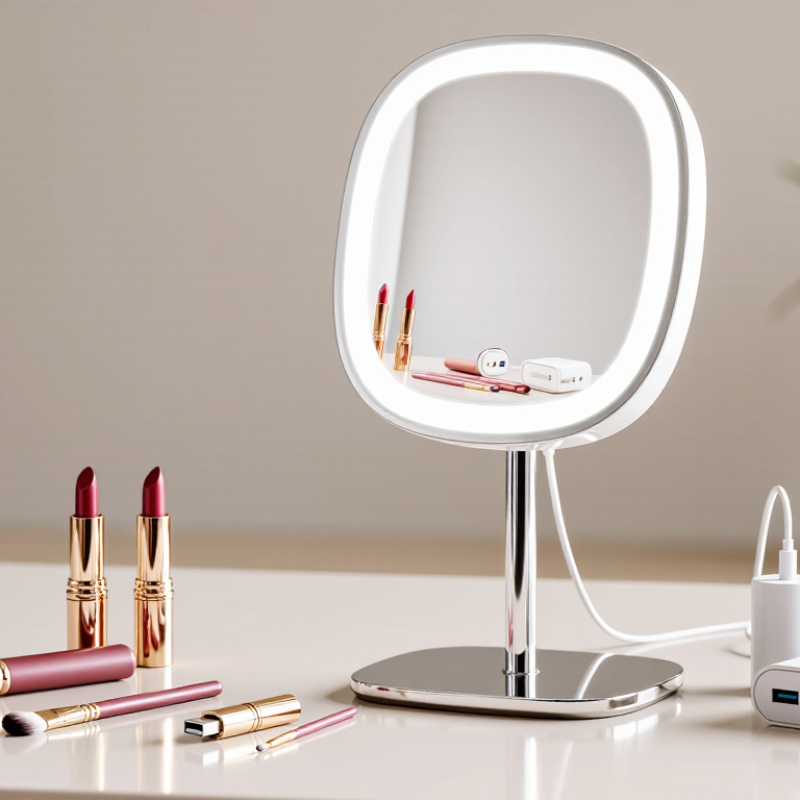
A flickering LED makeup mirror may follow the electrical supply: 50 or 60 hertz. Many drivers convert alternating current to direct current, but imperfect smoothing can leave brightness pulses. Full-wave rectification often produces ripple at 100 or 120 hertz—twice the mains frequency. That subtle distinction matters. A mirror may look steady to your eyes while a phone camera shows dark rolling bands.
CIE’s technical note TN 006:2016 describes methods for measuring time-modulated light. IEEE 1789-2015 provides frequency-based guidance for LED light modulation; neither document is a mirror-specific product test. The practical point: flicker depends on both pulse frequency and modulation depth, not frequency alone. A weak driver, aging smoothing capacitor, or incompatible dimmer can make the glow visibly stutter. I would not diagnose a mirror from camera bands alone; cameras can exaggerate effects that are hard to see directly.
Tips: Set brightness to full, then lower it slowly and watch for pulsing. Try another outlet, and record the mirror with your phone at several brightness levels. Persistent flicker, a hot plug, or crackling deserves attention. Stop using it and arrange inspection rather than opening the housing; the cause may be simple, but guessing is not a repair.
A flickering LED makeup mirror may have a simple power mismatch. Read the mirror’s rating label before replacing its adapter. Check the required output voltage, current, and whether the mirror expects DC or AC. The voltage should match exactly. The adapter’s current rating should meet or exceed the mirror’s stated requirement, provided the voltage and connector also match. More current capacity does not force extra current into a compatible mirror.
Small details matter. A plug can look right but have different polarity or fit loosely. Unplug the mirror, then inspect its label and the adapter’s output markings side by side. Check for a bent cable, dusty connection, or adapter that becomes unusually warm.
I used to focus on the LEDs themselves; that can be the wrong first guess. Still, an adapter mismatch is not the only cause. A loose socket or failing internal component may also cause flicker.
Don’t open the mirror or try a random power supply. If the correct adapter does not stop the flickering, or you notice heat, odor, or damaged wiring, stop using it and contact qualified support.
A little checking helps. Guessing doesn’t.
A flickering LED makeup mirror may have a dimmer, power adapter, or aging driver causing unstable light output. IEEE 1789 offers a useful way to assess that flicker, but its limits depend on frequency. For modulation from 90 to 1,250 Hz, the low-risk recommendation is below 0.08 times frequency, expressed as a percentage. At 120 Hz, that means under 9.6% modulation. Below 90 Hz, the low-risk guideline is stricter: below 0.025 times frequency. At 60 Hz, that is under 1.5%. The distinction matters.
These figures are guidance, not a guarantee that every person will feel comfortable under the light. A phone camera can show rolling bands even when flicker is hard to see directly, so video alone cannot diagnose a mirror. Try the mirror at full brightness, then at several dimmer settings. If flicker changes, the dimmer or driver may be involved. Check that the adapter is firmly connected, and stop using the mirror if the plug or housing feels unusually warm. Small detail, but important. I might have blamed the LEDs too quickly; a failing connection can produce similar symptoms. A technician or replacement adapter may be the safer next step.
| Light Modulation Frequency | IEEE 1789 Low-Risk Recommended Limit | Calculated Limit | What It Means for a Makeup Mirror |
|---|---|---|---|
| 50 Hz | Below 90 Hz: modulation < 0.025 × frequency | Less than 1.25% | At low modulation frequencies, the recommended limit is particularly strict. A visible or uncomfortable flicker warrants checking the power supply and dimmer. |
| 60 Hz | Below 90 Hz: modulation < 0.025 × frequency | Less than 1.50% | Do not assume that a mirror is flicker-free just because its light appears steady during normal viewing. |
| 90 Hz | From 90 to 1,250 Hz: modulation < 0.08 × frequency | Less than 7.20% | This is the start of the standard’s higher-frequency low-risk formula. The recommended limit is piecewise, not one formula across all frequencies. |
| 100 Hz | From 90 to 1,250 Hz: modulation < 0.08 × frequency | Less than 8.00% | A 100 Hz component can occur in some lighting systems powered from 50 Hz mains; the actual mirror’s driver design determines its light output. |
| 120 Hz | From 90 to 1,250 Hz: modulation < 0.08 × frequency | Less than 9.60% | A 120 Hz component can occur in some lighting systems powered from 60 Hz mains. This is a possible source, not a diagnosis by itself. |
| 400 Hz | From 90 to 1,250 Hz: modulation < 0.08 × frequency | Less than 32.00% | Higher-frequency modulation may be less noticeable to the eye, but measurement is needed to determine its frequency and depth. |
| 1,000 Hz | From 90 to 1,250 Hz: modulation < 0.08 × frequency | Less than 80.00% | Check the light output with a suitable flicker meter or photodiode-based instrument; a phone camera alone cannot reliably quantify modulation. |
| 1,250 Hz | At the upper boundary of the 90–1,250 Hz range | Less than 100% by the formula | The IEEE 1789 low-risk formula cited here applies through 1,250 Hz. Do not extrapolate it beyond that range as a guarantee of safety. |
Measurement note: Modulation percentage is commonly expressed as (maximum light output − minimum light output) ÷ (maximum light output + minimum light output) × 100. IEEE 1789 gives recommended practices; it does not certify a particular mirror or guarantee that every person will be free of symptoms. The low-risk recommendations are piecewise: below 90 Hz, the limit is < 0.025 × frequency; from 90 to 1,250 Hz, it is < 0.08 × frequency.
Quick troubleshooting: If the mirror flickers, test it at full brightness, then at lower dimmer settings; reseat accessible power connections; and, if possible, try a compatible power adapter. Persistent flicker may indicate an incompatible dimmer, a loose connection, or a failing driver. Disconnect power before inspecting the product, and contact a qualified technician if the wiring or power supply is damaged.
A flickering makeup mirror does not automatically need a new driver. First, measure its light output at the brightness setting you actually use. CIE Technical Note 006:2016 describes PstLM for short-term flicker and SVM for the visibility of stroboscopic effects. They assess different problems. A mirror may score well on one metric and poorly on the other, especially when dimmed.
The European Commission’s Ecodesign Regulation 2019/2020 sets full-load benchmarks of PstLM no higher than 1.0 and SVM no higher than 0.4 for covered LED light sources. These are useful reference points, not a guarantee that every mirror will feel comfortable. Ask a qualified technician to test with a flicker meter at full and reduced brightness, and record both readings. Phone-camera bands can suggest flicker, but rolling-shutter effects make them unreliable measurements. Check whether flicker changes when you touch the dimmer or move the plug; do not open an energized mirror. A loose connection can mimic driver failure. The numbers help, but they do not explain everything: reflections, viewing distance, and personal sensitivity matter too. A little uncertainty remains.
Assess flicker with CIE PstLM and SVM metrics before replacing the driver.
Example readings only—not measurements of a specific mirror. PstLM measures short-term light flicker; SVM measures stroboscopic effects. The dashed lines mark commonly applied EU ecodesign limits for applicable light sources: PstLM 1.0 and SVM 0.4. If readings exceed relevant limits, check dimmer compatibility, wiring, and connections, and verify with a suitable flicker meter before replacing the driver.
2026 Best LED Makeup Mirrors: Why Is Mine Flickering?
A flickering mirror often points to an unstable LED driver, a loose power connection, or a dimmer that does not match the light. It may appear as a faint shimmer on your cheeks, even when the mirror looks steady. Compare mirrors by asking for measured flicker performance, not just a “flicker-free” label. IEEE Std 1789-2015 gives guidance for modulated LED light: at 60 Hz, its “low-risk” recommendation corresponds to modulation below 4.8%, while its more conservative “no observable effect” level is below 1.5%. These are recommendations, not a guarantee that every person will perceive light identically.
For makeup, check dimming stability across the full range. A mirror that pulses or changes color at low brightness may have a poorly matched driver. Look for a stated CRI of 90 or higher, then check whether the maker reports how it was measured. CIE Publication 13.3 describes the color-rendering index method; CRI is useful, but it does not capture every aspect of color appearance. In practical terms, test the mirror beside a window: foundation should not look suddenly warmer or grayer when you switch it on.
Tips: Set the mirror to half brightness and film it in slow motion; dark bands can reveal flicker. Try another outlet and remove any inline dimmer. If flicker remains, stop using the mirror until its connection or power supply is checked.
Its power supply may not smooth electricity evenly. Weak components, a loose connection, or an incompatible dimmer can cause brightness pulses. Sometimes the cause is less obvious.
Household power commonly cycles at 50 or 60 Hz. Full-wave conversion can create brightness ripple at 100 or 120 Hz. The ripple’s strength matters too.
No. A phone camera may exaggerate light changes that are hard to see directly. Treat dark rolling bands as a clue, not a diagnosis.
Set the mirror to full brightness, then lower it slowly. Watch your face and the light for pulsing or color changes. Low settings can reveal problems.
Compare the mirror’s label with the adapter’s output. Match the voltage exactly, and check current, AC or DC, polarity, and connector fit. A plug that looks right may still be wrong.
Yes. Try another outlet and inspect the unplugged cable and connection for looseness or visible damage. I used to blame the LEDs. That was too quick.
Check for measured flicker performance and stable dimming across the brightness range. A stated CRI of 90 or higher can help with color accuracy. Try it beside a window.
Stop if flickering persists, the plug feels hot, or you notice an odor or crackling. Don’t open the housing. Arrange a qualified inspection instead. Guessing isn’t repair.
If you’re asking, “why is my led makeup mirror flickering,” the cause may be fluctuations in its power supply rather than a faulty light. Household mains power at 50 or 60 Hz can produce 100 or 120 Hz ripple in the LED output, especially when the driver or adapter does not smooth the current effectively. Check the mirror’s label and confirm that the adapter’s output voltage matches and its current rating is suitable. A mismatch, loose connection, or poorly regulated supply can contribute to visible flicker.
Before replacing the driver, assess the light using flicker measures such as CIE PstLM and SVM, which help describe visible flicker and stroboscopic effects. IEEE 1789 guidance also offers a useful reference: below 1,250 Hz, low-risk modulation is under 0.08 times the frequency. When comparing 2026 LED makeup mirrors, look for reliable flicker control, smooth dimming across brightness levels, and a color rendering index (CRI) of 90 or higher for more natural-looking makeup application.

NTC Beauty