Choosing the right mirror can change a dim room from frustrating to functional. In 2026, makeup mirrors offer more than simple reflection. They combine adjustable LEDs, color-temperature controls, magnification, and compact designs for bedrooms, bathrooms, and dressing tables with weak lighting.
So, how to choose a makeup mirror for dim rooms? Start with light quality, not decoration. A mirror with adjustable brightness helps when daylight disappears. A color temperature near natural daylight, around 4,000 to 5,000 Kelvin, can reveal foundation mismatches and uneven blush. Avoid harsh, cool-blue LEDs. They may make skin look pale and create shadows under the eyes. Look for side lighting or a fully illuminated frame. Light from only above can deepen facial shadows.
Professional makeup artist and educator Wayne Goss has often emphasized the importance of honest lighting: “Good lighting shows you what your makeup really looks like.” That principle remains practical. A 3x magnification panel can help with eyeliner, but using it for the whole face may distort proportions. A dimmable tabletop mirror suits small spaces, while a wall-mounted model saves desk area. Rechargeable models look convenient, though their batteries may weaken over time.
The best choice is not always the most expensive one. Check brightness, color accuracy, mirror size, charging options, and stability. Hold your hand near the light. Does your skin still look natural? Not perfect. Real rooms contain shadows, clutter, and changing daylight. A dependable mirror should handle those imperfections, not hide them.
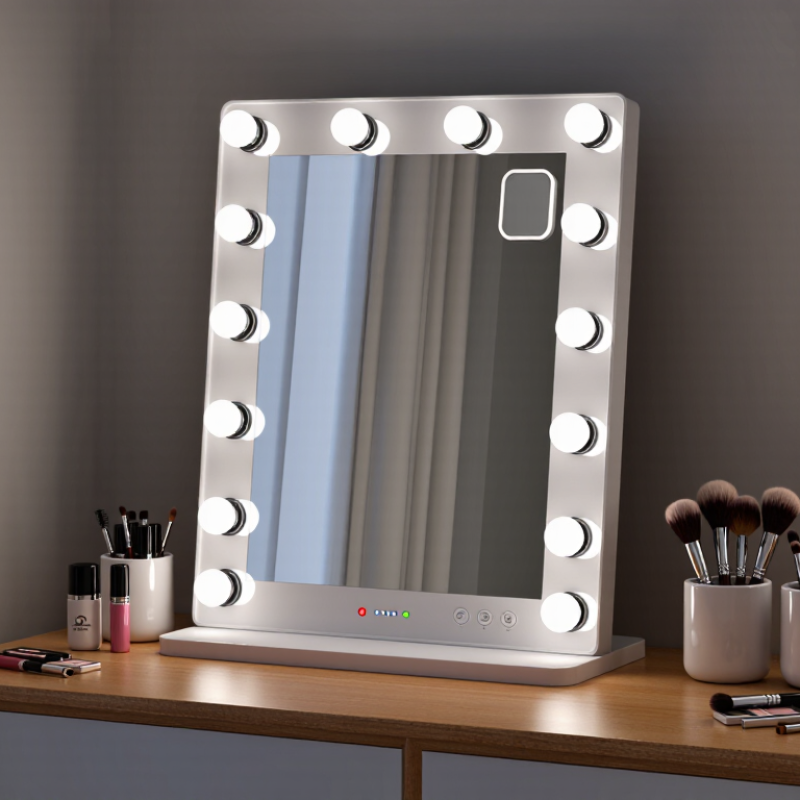
2026 Top Makeup Mirror Types for Dim Rooms: How to Choose?
Makeup mirrors for dim rooms should improve visibility without creating harsh shadows. LED illuminated mirrors are the most practical choice for daily routines. Their built-in lights frame the face evenly. Choose models with adjustable brightness, so delicate areas remain visible without glare. A color-temperature setting is also valuable. Cool light can reveal detail, while warm light looks softer.
Tri-fold mirrors suit small dressing tables and provide wider facial coverage. Their side panels help you inspect angles that a flat mirror misses. Magnifying mirrors work well for eyeliner, brows, and skincare details. However, high magnification can distort distance and encourage overcorrection. Use it briefly. Wall-mounted mirrors save counter space and keep the reflective surface steady. They are useful when your room has limited natural light.
A rechargeable mirror is convenient beside a bed or in a rental space. Check battery life, charging safety, and whether the light remains stable as power decreases. From practical use, adjustable lighting feels more helpful than maximum brightness. Too much light can hide texture rather than clarify it. I once preferred a highly magnified mirror, but it made ordinary skin look unnecessarily severe. That choice was not entirely wise. Consider the mirror’s size, light diffusion, and viewing distance together. A bright mirror cannot replace balanced room lighting.
Dim rooms need more than a brighter makeup mirror. They need controlled, balanced lighting. A useful target is 300–500 lux at the face, matching common IES task-lighting guidance for detailed visual work. Light should reach both cheeks evenly. Otherwise, one side may look warmer, darker, or more textured.
Color accuracy matters when choosing foundation, blush, and concealer. The U.S. Department of Energy’s solid-state lighting reports note that high-quality LED products can achieve CRI values above 90. Look for CRI 90 or higher, plus strong red rendering, often shown as R9. A color temperature between 4000K and 5000K usually resembles clear daytime light. However, cooler light can make skin appear pale. I still prefer adjustable settings, because bathroom walls and personal skin tones change the result.
Tips: Choose a mirror with diffused side lighting, not one exposed bulb above your forehead. Test it with a white towel and a red cosmetic item. The towel should look neutral. The red should remain vivid, not brownish. Check for flicker, too. The U.S. Department of Energy identifies flicker as a possible comfort and visibility concern in LED lighting. A mirror may look impressive online, yet perform poorly in a dim room. Test it at face level before deciding.
In a dim room, compare magnification before chasing extra lights. A 2024 report from Grand View Research identifies magnifying function as a major feature in cosmetic mirror demand. Choose 3x for eyeliner and brow work. It enlarges details without making your face feel strangely distorted. Higher levels can help with tiny areas, but they narrow the usable view. That is easy to underestimate.
Mirror size affects control. A surface around 15–20 centimeters wide can show most of the face, while smaller mirrors force repeated repositioning. For foundation, a wider mirror is usually more practical. Check the viewing angle too. A hinge or ball joint should tilt at least 30 degrees, allowing eye-level, chin-level, and side views. A fixed mirror may look elegant, yet it can create awkward wrist movement.
Lighting still changes the comparison. The U.S. Department of Energy reports that LED lighting uses at least 75% less energy than incandescent lighting. Look for even illumination around the face, not a bright strip above it. A color temperature near 4000K often feels balanced, though room wall colors can alter perception. Test the mirror from your normal sitting position. My own mistake was judging clarity while standing; the lower angle later revealed shadows beneath the eyes. A mirror can be technically sharp and still inconvenient.
In a dim room, the right makeup mirror depends on power, mounting, and control options. A rechargeable mirror suits renters and small vanities. Choose one with a battery rated for several daily uses. A plug-in model provides steadier brightness, especially during long grooming sessions. Hardwired lighting looks cleaner, but qualified installation is essential.
Brightness matters more than impressive specifications. Look for adjustable output around 400 to 800 lumens. A color temperature near 4000K to 5000K usually reveals skin tones clearly. High color rendering, preferably CRI 90 or above, can reduce misleading shadows. I once tested a very bright mirror that made details obvious but caused eye strain. More light is not always better.
Mounting changes how comfortably you use the mirror. Wall-mounted designs save counter space and keep the viewing angle stable. Extendable arms help when the sink or vanity sits unusually low. Freestanding mirrors are easier to move, though their bases can crowd a narrow surface. For controls, physical buttons work reliably with wet or powdered fingers. Touch controls look neat but may respond poorly to residue. Dimming, color adjustment, and memory settings are useful, but complicated menus become irritating quickly. A simple control layout often wins in real morning routines.
| Mirror Type | Typical Light Output | Color Temperature | Power Options | Mounting Method | Control Options | Best for Dim Rooms | Main Consideration |
|---|---|---|---|---|---|---|---|
| Wall-Mounted LED Mirror | 800–1,800 lumens | 3,000–6,500 K; often adjustable | Hardwired AC or plug-in adapter; typically 20–60 W | Fixed wall bracket or recessed installation | Touch sensor, wall switch, or dimmer-compatible switch | Bathrooms, dressing areas, and permanent vanities needing strong even light | Requires accurate wall measurements and suitable electrical planning |
| Tabletop LED Vanity Mirror | 300–1,000 lumens | 3,000–6,000 K; some models offer preset modes | USB, low-voltage adapter, or rechargeable battery; typically 5–20 W | Freestanding base with adjustable tilt | Touch button, push button, or rotary dimmer | Small bedrooms, rental homes, and flexible makeup stations | The base uses valuable counter space and may cast shadows if positioned too low |
| Tri-Fold LED Mirror | 400–1,200 lumens | 3,000–6,500 K; commonly switchable | USB or adapter; typically 8–25 W | Freestanding hinged panels | Touch control, button control, and brightness memory on some models | Users who need front, side, and close-up viewing in a narrow room | Hinges and cable placement should be checked before folding or storing |
| Magnifying Makeup Mirror with LED Ring | 150–600 lumens | 4,000–6,500 K | USB, adapter, or batteries; typically 3–12 W | Countertop stand, suction mount, or adjustable arm | On/off button and basic brightness control | Detailed eye makeup, shaving, skincare, and precision grooming | Magnification is intended for close work and should not replace a full-face mirror |
| Backlit Bathroom Mirror | 600–1,500 lumens | 3,000–6,000 K; warm, neutral, or cool settings | Hardwired AC or plug-in supply; typically 20–60 W | Wall-mounted cleat, French cleat, or recessed cabinet installation | Touch switch, wall switch, dimmer, and sometimes motion activation | Moisture-prone bathrooms where a clean, space-saving installation is preferred | Confirm bathroom electrical safety requirements and the product's moisture rating |
| Adjustable-Arm LED Mirror | 300–900 lumens | 3,000–6,500 K; adjustable on selected models | Plug-in adapter or hardwired low-voltage supply; typically 8–25 W | Wall-mounted swing arm or cabinet-side mount | Touch control, cord switch, or wall switch | Compact bathrooms and vanities where the light needs to move closer to the face | The wall or cabinet must support the arm's extended load and movement |
| Smart LED Makeup Mirror | 300–1,200 lumens | 2,700–6,500 K; digitally adjustable | USB-C, adapter, or rechargeable battery; typically 5–30 W | Tabletop, wall-mounted, or cabinet-integrated | Touch panel, remote control, app, voice control, or preset scenes | Users who want repeatable lighting settings in rooms with changing daylight | Wireless features may require charging, pairing, and compatible home connectivity |
Choosing a makeup mirror for a dim room starts with the light, not the frame. Observe your space at night and note where shadows fall across your face. A mirror with adjustable brightness helps, but excessive brightness can hide uneven foundation.
Aim for natural-looking light with a color rendering index of 90 or higher. Neutral white light, around 4000K to 5000K, usually shows skin tones more accurately.
Check the mirror’s size and placement. Your face should remain visible without leaning forward or turning sideways. For a narrow desk, a compact tabletop mirror may work better than a large wall model.
Choose diffused LEDs instead of exposed points, which can create sharp shadows around the nose and eyes. Test the controls before buying. Brightness should change smoothly, and the switch should be usable with clean or damp hands.
Consider magnification carefully. A moderate level, such as 3x, can support eyeliner and brow work, while stronger magnification may distort your overall appearance.
I once relied on a highly magnified mirror and applied too much blush. The result looked fine indoors, but harsh daylight disagreed. That mistake reminded me to check makeup under two light sources.
A stable base, accurate color, and easy cleaning matter more than decorative features. Choose the mirror that fits your routine, not merely the darkest corner of your room.
An LED illuminated mirror is usually practical for daily makeup. Choose evenly diffused light around your face. Adjustable brightness matters more than maximum brightness.
Neutral white light between 4000K and 5000K often shows skin tones clearly. Cooler light reveals small details. Warmer light feels softer, but room colors may change its appearance.
The light should reveal your face without creating glare. Excessive brightness can hide uneven foundation and skin texture. Test the mirror at night, then reduce the brightness slightly.
Around 3x magnification usually supports eyeliner, brows, and small skincare details. Stronger magnification narrows the view and may distort your appearance. Use it briefly.
A surface about 15–20 centimeters wide can show most of your face. Smaller mirrors require repeated repositioning. Wider surfaces work better for foundation and face balancing.
A hinge or ball joint should tilt at least 30 degrees. This supports eye-level, chin-level, and side views. A fixed mirror may force awkward wrist movements.
Yes. Side panels show angles that a flat mirror can miss. They provide wider coverage without requiring a large wall area.
It can be convenient when outlets are limited. Check battery life, charging safety, and light stability as power decreases. A bright mirror cannot replace balanced room lighting.
Do not judge clarity only while standing. Lower sitting angles may reveal shadows beneath the eyes. I once chose high magnification and applied too much blush; daylight disagreed.
Choosing the right makeup mirror for a dim room requires more than selecting the brightest light. This guide explores mirror types designed for low-light spaces, including tabletop, wall-mounted, and portable options, while explaining how adjustable brightness, color temperature, and even illumination can improve visibility and support more accurate makeup color decisions. It also covers how magnification levels, mirror size, and viewing angles affect comfort, precision, and overall usability.
The article provides practical advice on how to choose a makeup mirror for dim rooms by comparing power sources, installation methods, and control options such as touch buttons, switches, or sensors. A step-by-step selection process helps readers assess their room layout, daily routine, lighting needs, available space, and budget. By considering these factors together, users can find a mirror that offers clear reflection, flexible positioning, reliable performance, and a more convenient makeup experience in low-light environments.

NTC Beauty