What Is the Best Lighting for Applying Makeup at Home?

Time:2026-09-18 Author:Sienna
0%

Choosing what lighting is best for applying makeup at home can change the accuracy of every product decision. A foundation may look perfect indoors, then appear orange near a window. Blush can become too strong. Concealer may suddenly seem gray.

Makeup artist Bobbi Brown has offered a practical rule: “The best light is natural light.” That advice remains useful because soft daylight reveals color, texture, and uneven blending more honestly. Place a mirror near a window, but avoid direct sunlight. Harsh rays create deep shadows and exaggerate pores. North-facing light often feels gentler, although the direction depends on your room and the season.

Not every home has reliable daylight. In that case, choose a high-CRI LED light, ideally above 90, with a neutral color temperature around 4500K to 5500K. Position two lights beside your face, slightly above eye level. This reduces the shadow under your chin and prevents one side from looking darker. Avoid a single ceiling bulb. It can make your eyes look tired and your foundation uneven.

A simple test helps. Apply one cheek beside the window and inspect it under your chosen lamp. Then check your face near the front door or outdoors. The result may not match perfectly. That is normal. Lighting changes throughout the day, and even experienced makeup users can overcorrect. Aim for balanced, soft, color-accurate light rather than a flawless setup. The best choice is the one that shows your makeup clearly without distorting your skin.
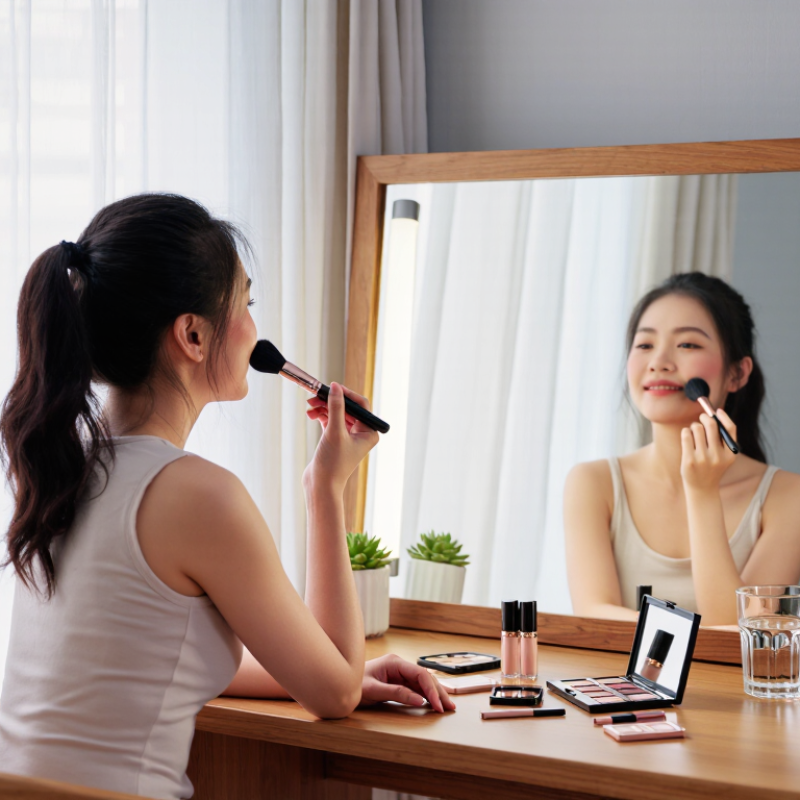
What Is the Best Lighting for Applying Makeup at Home?

Define Color Accuracy: Why CRI 90+ Matters for Makeup Application

Good makeup lighting starts with color accuracy, not brightness.
A light can look powerful while making skin tones appear dull, yellow, or overly pink. Color Rendering Index, or CRI, measures how naturally a light reveals colors compared with a reference source. For makeup application, CRI 90 or higher is a practical standard. It helps foundation, blush, concealer, and lipstick appear closer to their real shades.

I noticed this difference when matching concealer beside a window. Under a low-CRI lamp, two similar shades looked almost identical. In daylight, one appeared noticeably warmer. That small error became obvious outdoors. A CRI 90+ light reduces this surprise, although CRI is not perfect. It may not show every red tone accurately. I still check strong reds and pinks in natural daylight when possible.

Placement matters too. Put the light near eye level, facing your skin. Avoid relying on one ceiling light, which creates shadows beneath the eyes and nose. A neutral color temperature around 4000K to 5000K often gives a balanced working view. Keep the light close enough for even coverage, but not so close that it feels hot. A mirror with side lighting can reveal uneven blending more clearly. I once trusted a bright front lamp and missed a dark foundation line along my jaw. Better lighting would have helped, but slowing down would have helped more.

Choose the Right Color Temperature: The 4000–5000K Daylight Range

What Is the Best Lighting for Applying Makeup at Home?

Choose the Right Color Temperature: The 4000–5000K Daylight Range

For home makeup, 4000–5000K usually creates the most practical daylight effect. Around 4500K, skin tones look balanced rather than overly yellow or blue. This range helps reveal uneven foundation, missed blending, and subtle redness near the nose.

The Illuminating Engineering Society explains that color temperature affects appearance, but it does not measure color accuracy. Check the light’s color rendering quality as well. The European standard EN 12464-1:2021 uses 500 lux and a minimum Ra 90 as useful benchmarks for beauty-salon lighting. At home, position the light beside or in front of your face, not directly above it. A mirror surrounded by even illumination reduces shadows under the eyes and chin.

Keep it simple. Use a dimmable fixture when possible. I have found that 5000K can expose details clearly, but it may feel harsh in a small room. A 4000K setting often looks gentler after several minutes. That is not a universal rule. Wall color, window light, and your own vision can change the result. The U.S. Department of Energy’s reports on solid-state lighting also warn that CCT alone cannot predict visual quality, so test foundation under both indoor and natural light before leaving home.

Measure Brightness Correctly: Target Illuminance Near 1000 Lux

Applying makeup at home requires light that shows color and texture accurately. A useful target is about 1000 lux at your face, not simply a bright-looking room. Lux measures light reaching a surface, so brightness alone can mislead you.

Place a basic lux meter where your face will be, with the sensor facing the light. Measure near your forehead, cheeks, and chin. Readings may vary across these areas. I once measured the desk instead of my face and got a reassuring, but useless, result. Keep the light close to eye level to reduce shadows under the nose and jaw. Soft, evenly distributed light usually works better than one harsh overhead source. A high color-rendering quality also helps foundation and blush appear more natural.

Tips: Check the reading while seated at your usual mirror. Aim for roughly 800 to 1200 lux, with 1000 lux as a practical reference. Avoid mixing warm and cool light sources. They can make skin tones look confusing. Test makeup near a window, too. Daylight changes constantly, and that can expose mistakes indoor lighting hides. My setup still needs adjustment on cloudy mornings. That is worth noticing. Excuse the imperfect reading, then recheck before changing your makeup.

Position and Diffuse the Light for Even, Shadow-Free Facial Coverage

Good makeup lighting starts with position, not brightness. Place the light directly in front of your face, slightly above eye level. Keep it close enough to soften shadows under the eyes, nose, and chin. Overhead lighting creates harsh hollows and can make foundation look uneven. Avoid it.

A broad light source works better than a small, intense bulb. A frosted panel, diffused window, or fabric-covered lamp spreads illumination across both cheeks. The International Commission on Illumination’s CIE 015:2018 defines standard daylight D65 at approximately 6504 K. For home makeup, neutral light around 4000–5000 K usually reveals skin tones more honestly than very warm light. The IES Lighting Handbook also emphasizes vertical illumination for clearer facial modeling, supporting a front-facing setup.

Color quality matters. CIE 224:2017 introduced TM-30, which evaluates color fidelity through Rf and color gamut through Rg. Choose lighting with Rf near 90 or higher, and Rg close to 100 when possible. These figures can reduce surprises between your mirror and outdoor light. Still, numbers are not everything. I once trusted a bright lamp that showed detail but produced a gray cast. My technique needed adjustment. Test the light with a bare face, then check your makeup beside a window. Keep the mirror centered, and place matching lights on both sides. That small balance prevents one cheek from appearing darker.

Compare Ring Lights, LED Panels, and Vanity Fixtures by Performance Metrics

At-home makeup needs light that reveals texture, not merely bright light. EN 12464-1:2021 uses 500 lux as a reference for many beauty-care tasks, but face-level measurement matters more than the room’s ceiling reading. A ring light can deliver even frontal illumination and soft shadows. However, its circular reflection may distract during detailed eye work. Measure lux beside your mirror, not behind it.

LED panels usually provide stronger control. A diffused panel can produce a wider beam, reducing harsh highlights on dry skin. Two panels, placed slightly above eye level, often show facial contours more naturally than one ring light. Check color quality through CRI and TM-30 results. CIE 015:2018 explains why CRI alone can miss color shifts. IES TM-30-18 adds fidelity and gamut metrics, including Rf and Rg. Aim for high color fidelity, especially for foundation and blush matching.

Vanity fixtures with vertical lights beside the face can be the most practical arrangement. They reduce the nose shadow common with overhead lamps. They also occupy more wall space. IEEE 1789-2015 links excessive light modulation with potential visual discomfort, so inspect flicker through a slow-motion phone video. This is not a laboratory test. I have found it useful, but imperfect. Set the color temperature near 4000–5000K, then test makeup near a window. A perfect setup indoors may still look wrong outside.

What Is the Best Lighting for Applying Makeup at Home?

Comparison of ring lights, LED panels, and vanity fixtures using typical category-level performance metrics.

LED panels provide the highest typical illuminance and color accuracy, while ring lights offer the most even, shadow-reducing illumination. Vanity fixtures create a familiar bathroom-style setup but generally provide less adjustable light. Scores are normalized from common category specifications: CRI, illuminance at 0.5 m, color-temperature adjustability, and shadow control.

FAQS

What illuminance level works well for makeup at home?

Aim for about 1000 lux at your face. A practical range is 800 to 1200 lux. A bright-looking room may still measure poorly.

How should I measure makeup lighting?

Place a basic lux meter where your face normally sits. Keep its sensor facing the light. Check your forehead, cheeks, and chin separately. I once measured the desk instead. The result was useless.

Where should the light be positioned?

Place it directly in front of your face, slightly above eye level. Keep it close enough to soften shadows under your eyes, nose, and chin. Avoid placing one strong light directly overhead. Avoid it.

What type of light creates even facial coverage?

Use a broad, diffused source rather than a small, harsh bulb. A frosted panel or diffused window can illuminate both cheeks evenly. A fabric-covered lamp may also soften sharp shadows. Soft light helps.

Which color temperature is suitable for makeup application?

Neutral light around 4000–5000 K usually shows skin tones more honestly. Very warm light can make colors appear misleading. Avoid mixing warm and cool sources. They create confusion.

How important is color-rendering quality?

Choose lighting with color-rendering performance near 90 or higher when possible. A balanced color gamut near 100 can reduce outdoor color surprises. Numbers help, but they are not perfect. One bright lamp still gave me a gray cast.

Should I use matching lights on both sides of the mirror?

Yes, matching lights can reduce uneven shadows across your face. Keep the mirror centered between them. This prevents one cheek from looking darker. Small changes matter.

Should I check makeup beside a window?

Yes, compare your makeup near a window after applying it indoors. Daylight changes throughout the day, especially during cloudy mornings. It can reveal mistakes that indoor lighting hides. Recheck before changing everything.

Conclusion

The answer to “what lighting is best for applying makeup at home” is lighting that reproduces colors accurately, provides balanced brightness, and minimizes shadows. Choose a light source with a Color Rendering Index (CRI) of 90 or higher so foundation, blush, and other products appear close to their true shades. A color temperature between 4000K and 5000K offers a neutral daylight effect, helping you judge tones without making the skin look overly warm or cool. Aim for approximately 1000 lux on the face, measured at the position where makeup is applied, rather than relying only on a fixture’s wattage or advertised brightness.

Position the light near eye level and in front of the face, or use multiple sources from slightly different angles to reduce harsh shadows. A diffuser can soften glare and create more even coverage across the forehead, cheeks, and chin. When comparing ring lights, LED panels, and vanity fixtures, focus on CRI, adjustable color temperature, measured illuminance, diffusion quality, and light distribution. The most suitable option is the one that delivers consistent, comfortable, shadow-free illumination for precise application.

Sienna

Sienna

Sienna is a skilled marketing professional with a deep expertise in our company’s core products and services. With a passion for innovation and detail, she plays a pivotal role in crafting insightful blog posts that not only highlight the unique features of our offerings but also provide valuable......