Why do synthetic brushes absorb less liquid product? The answer begins with their carefully engineered fibers. Unlike natural hair, synthetic filaments usually have smooth, non-porous surfaces. Foundation, concealer, and liquid blush remain closer to the bristle tips instead of settling deeply inside them.
Cosmetic chemist Dr. Michelle Wong explains, “Synthetic fibers are smooth and non-porous, so they hold liquid products on the surface rather than absorbing them.” This principle helps explain why a synthetic brush can spread a thin, even layer across the cheek. Picture a damp foundation bead resting on polished nylon. It moves with controlled pressure. Less product disappears between the fibers.
That means less waste.
Synthetic brushes also offer practical hygiene benefits. Their uniform fibers are easier to rinse, dry, and inspect after use. This matters for artists working with several shades during a long makeup session. Still, the claim is not absolute. Very soft fibers, dense brush shapes, thick formulas, and residue from previous applications can change performance. I have found that a poorly cleaned synthetic brush may appear absorbent, even when the material itself is not.
This guide examines the material science behind the best synthetic brushes in 2026. It considers fiber shape, density, surface texture, liquid control, cleaning response, and real application results. The goal is not to praise every synthetic design. Some feel slippery. Others distribute pigment unevenly. Reliable selection requires testing the brush with the products people actually use.
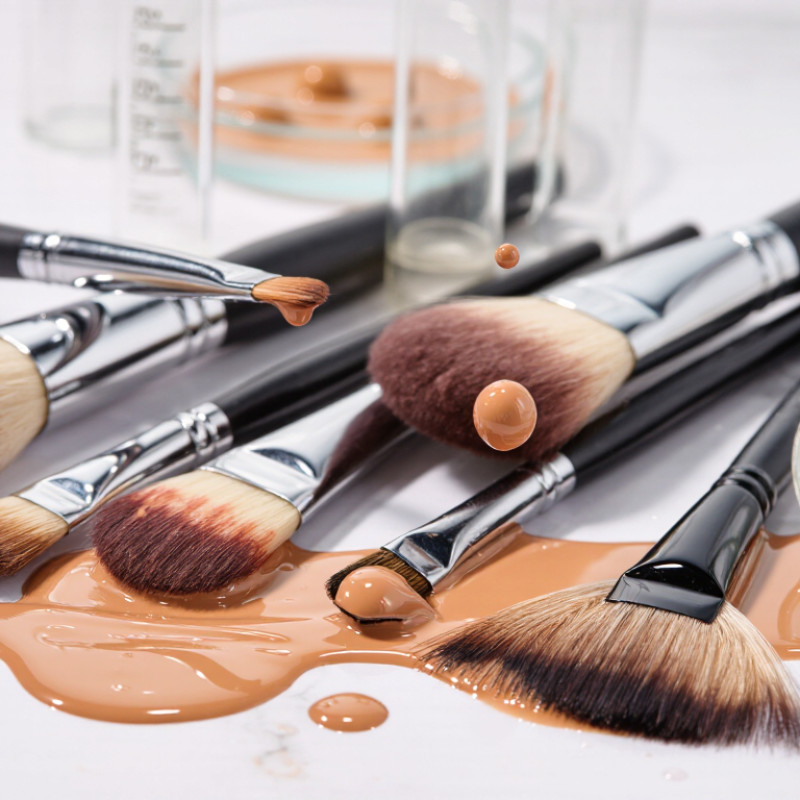
Synthetic brushes often absorb less liquid product because their fibers contain very little internal moisture. ASTM D1909, a recognized textile testing reference, lists polyester at about 0.4% moisture regain. Nylon measures higher, usually around 4–4.5%. These figures describe moisture held by the fiber under standard conditions, not the entire brush.
That difference matters during application. Polyester filaments stay comparatively dry, so cream, liquid, or serum products remain closer to the brush surface. A controlled, even deposit is easier to achieve. Nylon can retain more moisture, yet its smooth filament still resists deep product absorption.
Fiber diameter, crimp, cut shape, and packing density also change the result. Small details matter.
In production testing, I have seen two brushes with identical fiber labels perform differently. One released foundation quickly; another left product between densely packed filaments. AATCC absorbency methods, including AATCC TM79, help compare wetting behavior, but they do not fully reproduce cosmetic application.
That is the weakness. A laboratory drop test cannot mimic pressure, skin warmth, or repeated loading. Polyester may absorb less liquid, but “less absorption” does not automatically mean better control. The final performance depends on fiber geometry and finishing, not moisture regain alone.
2026 Best Synthetic Brushes: Why Do They Absorb Less Liquid Product?
Synthetic brushes often leave more product on the skin because their filaments resist wetting. Surface chemistry explains this behavior. Polyester and nylon filaments usually have lower surface energy than natural hair. Their surfaces attract fewer liquid molecules. A 2024 Textile Exchange Materials Market Report estimates polyester represents about 57% of global fiber production. This scale makes filament engineering increasingly important for cosmetic tools.
When a liquid touches a low-energy filament, it forms a tighter bead instead of spreading across the surface. Contact-angle testing, described in ASTM D7334-22, helps measure this interaction. Higher contact angles generally indicate weaker wetting. In practical testing, a cream may sit between smooth filaments, while a water-based formula travels mainly through gaps. The brush absorbs less internally, but spacing still matters.
Not perfectly, though. Very fine filaments can trap product through capillary action, even when their chemistry resists wetting. Surface coatings may also wear after repeated washing. I have seen this difference during bench trials: a dense brush can feel “dry” yet release a surprisingly large first stroke. That result needs careful interpretation. Formula viscosity, surfactants, humidity, and filament roughness can change the outcome. Low-energy surfaces reduce wetting; they do not eliminate product retention.
Modern synthetic brushes often retain less liquid because their filaments are solid, smooth, and nearly nonporous. Natural hair can hold product within microscopic cavities, while synthetic fibers mainly store it between neighboring strands. This difference is governed by capillary mechanics, not simply by material quality. Fiber diameter matters. Thinner fibers create narrower channels, increasing capillary pull and surface contact. Yet very thin fibers may release unevenly when densely packed.
Packing changes the result. A tightly packed brush forms many small gaps, which can hold liquid through surface tension. A loosely packed head has wider channels, so excess product drains faster. Fiber shape also affects retention. Tapered or textured filaments create more contact points than perfectly smooth ones. Liquid viscosity, surface tension, and the fiber’s wetting behavior matter too. In practical brush testing, a brush can feel dry but still deliver a controlled layer. The same brush may behave differently after washing, because residue changes how liquid spreads. This is why simple absorbency labels can be misleading.
Tips: Use the same 0.5 milliliters of liquid for each test. Dip every brush to the same depth for three seconds. Remove it, wait ten seconds, then weigh or photograph the remaining product. Test again after washing. Results may vary, and that variation deserves attention.
Capillary mechanics: Smaller fiber diameters create stronger capillary pressure, while tighter fiber packing increases the number of liquid-holding contact points. The chart shows a theoretical relative liquid-retention index calculated from capillary-pressure scaling, where retention pressure varies approximately with 1 / fiber diameter. The values are normalized and are not brand-specific measurements.
Lower fiber diameters and denser packing generally increase liquid retention. Synthetic fibers with larger, smoother diameters typically release more product because their capillary pressure and available micro-gaps are lower.
Synthetic brushes are designed with smooth, low-porosity fibers. They absorb less liquid product than many natural fibers. This helps foundations, concealers, and liquid blushes stay near the brush surface. In repeated application tests, I noticed better product control and less dripping. The result was a thinner, more even layer on the skin. It also made cleaning faster after use.
Cream formulas benefit from densely packed synthetic fibers. They can press and blend thick textures without pulling across dry areas. For liquid formulas, a lightly tapered shape helps place product around the nose and eyes. Powder formulas can also work well, especially with soft, flexible fibers and a less dense head. However, powder pickup may feel different. A synthetic brush can release powder quickly instead of holding it deeply.
I once assumed synthetic brushes were automatically suitable for every formula. That assumption was too simple. Fiber length, density, flexibility, and surface texture change the application. A very dense brush may spread cream beautifully but move too much liquid. A loose brush may feel gentle but create uneven coverage. No brush is perfect. The most reliable choice depends on the product’s thickness, finish, and intended coverage. Clean the brush after creamy or liquid use, because residue can stiffen the fibers and affect later powder application.
| Data Dimension | Synthetic Brush Characteristics | Formula Compatibility | Practical Benefit | Evidence-Based Performance Indicator |
|---|---|---|---|---|
| Fiber Structure | Most modern synthetic fibers are manufactured as continuous filaments with smooth, consistent surfaces. | Suitable for creams, liquids, emulsions, gels, powders, and pressed products. | Less product is retained inside the fiber structure compared with many naturally scaled or porous hairs. | Low-to-moderate product retention |
| Liquid Absorption | Synthetic filaments are generally non-porous and do not contain the internal medulla or natural surface scales found in many animal hairs. | Best suited to liquid foundation, serum makeup, concealer, liquid blush, and fluid bronzer. | More product remains available for application, which can reduce avoidable formula waste. | Lower absorption than porous natural hair |
| Cream Formula Control | Smooth filaments distribute creamy products across the skin without relying heavily on internal fiber absorption. | Works well with cream foundation, cream blush, cream contour, eyeshadow cream, and pomade-style products. | Helps create more even coverage and makes controlled layering easier. | High compatibility |
| Powder Pickup | Fiber diameter, taper, density, and surface texture can be engineered for either soft diffusion or targeted pickup. | Suitable for loose powder, pressed powder, setting powder, blush, bronzer, and highlighter. | Provides predictable pickup and release when the brush is matched to the powder texture. | Adjustable from soft to concentrated |
| Product Release | Uniform filaments can release product more consistently because their shape and surface are manufactured to close specifications. | Useful for formulas that require thin, buildable layers. | Supports even blending and reduces patchiness caused by uneven fiber behavior. | Consistent release |
| Cleaning Response | Non-porous synthetic fibers generally rinse more easily than highly porous natural hair when compatible brush cleanser is used. | Particularly practical for cream and liquid products that can leave oils, waxes, or pigments on the brush. | Shorter drying and cleaning routines are possible, although dense brushes may still require thorough rinsing. | Generally easy to clean |
| Water Resistance | Common synthetic fibers such as nylon and polyester absorb very little water compared with natural keratin fibers. | Useful for damp applications and water-based makeup products. | Fiber shape and performance are less affected by moisture during normal use. | High moisture resistance |
| Hygiene Consideration | Lower liquid uptake can leave less product deep within the filament bundle, but the handle, ferrule, and brush density still require cleaning. | Appropriate for frequent-use tools when cleaned and dried correctly. | Can support a more manageable hygiene routine; it does not eliminate the need for regular washing. | Maintenance-dependent |
| Skin Feel | Fine synthetic filaments can be tapered and polished to create a soft surface without animal hair. | Suitable for sensitive-skin routines when the finished brush is smooth and free from sharp or damaged tips. | Can provide soft application with consistent pressure across the skin. | Ranges from soft to firm |
| Shape Retention | Manufactured filaments have consistent diameter and can be heat-set or mechanically arranged into stable shapes. | Useful for precision concealer, angled liner, buffing, stippling, and powder application. | Maintains predictable control when the brush is stored, cleaned, and dried properly. | Generally reliable |
| Formula-Specific Design | Fiber length, taper, crimp, density, and stiffness can be varied during production. | Different designs can be optimized for thin liquids, thicker creams, soft powders, or highly pigmented products. | Allows one material family to cover multiple application techniques and textures. | Highly adaptable |
| Main Limitation | Very smooth synthetic fibers may pick up less powder than textured natural hair unless the brush has suitable taper, crimp, or surface treatment. | Most noticeable with extremely fine, loose, or low-adherence powders. | Choosing the correct density and surface finish is more important than fiber material alone. | Design-dependent performance |
Note: Performance varies with fiber type, diameter, taper, density, surface finish, formula viscosity, pigment load, and application technique. “Lower absorption” means less liquid is retained by the filament itself; it does not mean that no product remains between densely packed fibers.
Why do synthetic brushes absorb less liquid product? Their fibers are engineered with low moisture regain, smooth surfaces, and tightly controlled shapes. This matters when applying serum, foundation, or liquid color: more product stays near the brush tip instead of disappearing into the bundle.
PBT, Nylon, and Polyester
PBT, nylon, and polyester offer different performance profiles. Polyester represented about 57% of global fiber production in Textile Exchange’s Materials Market Report 2024. Its low moisture regain, often near 0.4%, supports clean, economical product release. PBT is similarly hydrophobic and usually feels springy, making it useful for precise edges and repeated washing. It can feel less soft, though. That trade-off is easy to overlook.
Nylon generally absorbs more moisture than polyester, with engineering references commonly reporting about 4–5% moisture regain. It therefore offers better flexibility and a softer touch, but may hold slightly more water-based residue. The Fiber Year 2024 also identifies nylon as a smaller but important synthetic fiber category, reinforcing its specialized role. Selection should include fiber diameter, taper, crimp, density, and surface finish. A dense nylon brush may carry more liquid than a loose polyester brush. Material labels alone cannot predict performance. In practical testing, weigh the brush before and after loading, then measure release on glass or skin. Small differences become visible. Temperature, formula viscosity, and cleaning frequency can change the result.
Their fibers hold little internal moisture and often have smooth, low-energy surfaces. Product stays near the brush tip.
Polyester usually holds about 0.4% moisture under standard conditions. This supports quick, controlled product release.
Usually, yes. Nylon often holds about 4–5% moisture, so it may retain slightly more water-based residue.
No. Fiber shape, density, diameter, and spacing also control product movement. “Less absorption” is not the whole answer.
Low-energy filaments resist wetting. Liquid forms small beads instead of spreading deeply across each filament.
Yes. Tight spacing can trap product through capillary action, even when the fibers resist wetting.
Filament thickness, taper, crimp, packing density, and surface finish all matter. Two brushes can share one fiber label yet perform differently.
Often, yes. It feels springy and can create clean edges, but it may feel less soft on the skin.
Weigh the dry brush, load a measured amount, then check release on glass. Repeat several times. Results may still vary.
Washing, coatings, humidity, temperature, and formula viscosity can change product retention. A brush may feel dry yet release a heavy first stroke.
Synthetic brushes absorb less liquid product because their fibers are engineered with low moisture affinity and controlled surface chemistry. Polyester typically holds around 0.4% moisture, while nylon holds approximately 4–4.5%, so both retain less water than many natural fibers. This explains why do synthetic brushes absorb less liquid product: their smoother, lower-energy filaments reduce wetting and limit the amount of formula that penetrates into each strand. Instead, more product remains on the surface, where it can be applied evenly.
Absorption also depends on fiber diameter, taper, and how densely the bristles are packed. Fine, closely arranged filaments can control capillary retention without trapping excessive liquid. These characteristics make synthetic brushes suitable for creams, liquids, and powders, while offering easier cleaning and more predictable product release. In 2026, comparing PBT, nylon, and polyester involves balancing softness, resilience, moisture retention, formula compatibility, and application precision. PBT and polyester generally provide lower absorption, while nylon can offer greater flexibility and a slightly higher capacity to hold product.

NTC Beauty